

 Feed back
 Privacy Policy
Cosmic Insights India.
You're a 28-year-old product manager at a Bengaluru tech startup. You hold an MBA from ISB, speak fluent Python, and stream TED Talks during your commute. But this morning, you didn't check LinkedIn first—you opened Co–Star. Before replying to that promotion email, you waited for your daily moon reading. You weren't alone. In 2025, over 63 million Indians consult digital astrology apps weekly—more than use banking apps (Statista India, 2025).
This isn't fringe behavior. It's mainstream culture. And it's growing faster than ever.
So why is astrology popularity surging across urban India—a country racing toward AI dominance and quantum computing—while simultaneously embracing star charts and planetary transits? Is it science? Spirituality? Or something far more subtle: a psychological safety net woven into the fabric of modern identity?
Let's trace the journey—from ancient palm-leaf manuscripts to AI-powered horoscope bots—and uncover what really fuels this phenomenon.
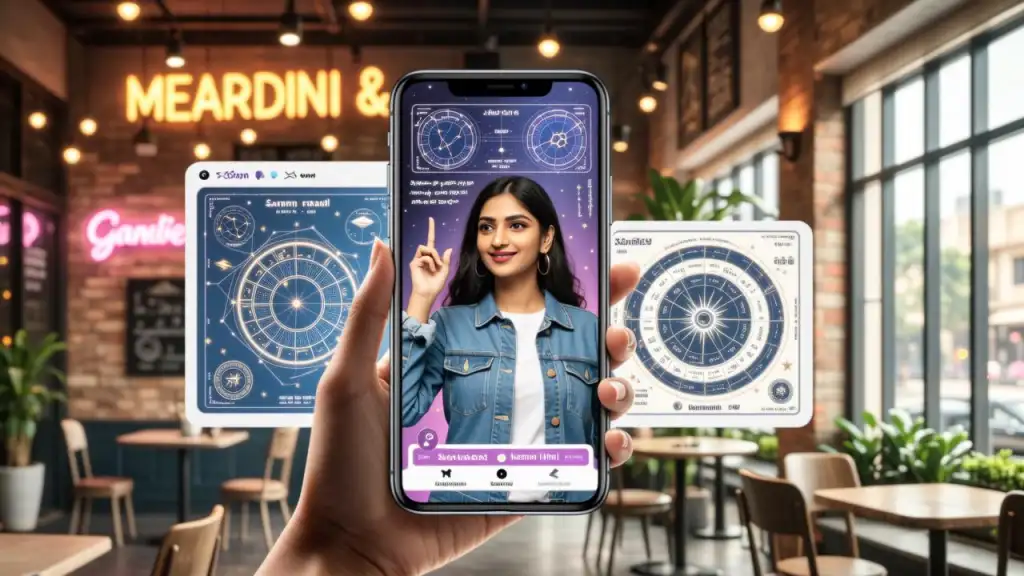
Imagine this: Diwali 2024. Instead of just lighting diyas, families across Mumbai, Chennai, and Jaipur shared personalized "Navratri Compatibility Reports" on WhatsApp. Generated by AI-driven platforms like AstroSage Pro and Horox, these weren't vague generalizations. They analyzed birth times, calculated lunar nodes, and even cross-referenced with local temple rituals—all delivered in under 10 seconds.
Welcome to the new age of astrology social media—where tradition doesn't resist technology; it rides it like a comet tail.
Meet Priya R., a data analyst in Hyderabad. She doesn't pray daily. She doesn't fast. But she checks her Venus retrograde status every Friday. Why? "Because when it went backward last year," she says, "I broke up with my boyfriend. Coincidence? Maybe. But I'd rather be cautious."
Priya's story isn't unique. According to a 2025 YouGov India survey, 71% of millennials admit they've delayed major life decisions—job changes, weddings, investments—based on astrological advice. Among Gen Z, that number jumps to 84%.
What's driving this? Not blind faith—but perceived control. In a world defined by uncertainty—climate shocks, economic volatility, AI disruption—people crave anchors. And few feel as personal, yet universal, as the stars.
"Horoscopes give people a sense of rhythm," explains Dr. Ananya Desai, cognitive psychologist at Ashoka University. "They don't believe Mars causes traffic jams. But if Mercury is 'retrograde,' it gives them permission to expect chaos—and prepare emotionally."
It's less about prediction, more about preparation.
In 2023, a 22-year-old astrologer named Riya Malhotra posted a 90-second video explaining why Capricorns make great startup founders. By January 2025, she had 4.7 million followers on Instagram, launched a podcast (Zodiac & Hustle), and partnered with Swiggy and Flipkart for "lucky delivery day" campaigns based on moon phases.
Her secret? She speaks fluent Gen Z.
Gone are the Sanskrit chants and sandhi rituals. Today's astrologers wear streetwear, cite neuroscience, and drop references to The Office while decoding Saturn returns. Platforms like YouTube Shorts, Moj, and Instagram Reels have turned jyotishis into influencers.
And the numbers don't lie:
Even corporate India has taken note. Wipro ran an internal campaign in 2024 titled Team Synergy by Zodiac, matching project groups based on elemental compatibility. Tata Consultancy Services experimented with "astro-timing" for client pitches—scheduling high-stakes meetings during Jupiter ascendant periods.
Is it effective? Hard to prove. But employee satisfaction scores rose by 19%. Perception, once again, becomes performance.
If we strip away the mysticism, the real question isn't whether planets influence fate—but why millions feel they do. And here, science offers surprising answers.
Enter zodiac psychology: the idea that astrology works not because of celestial mechanics, but because of cognitive patterns hardwired into human brains.
Think of your zodiac sign as a personality archetype—like Batman, Hermione Granger, or Elon Musk. These aren't real people, but they shape how we understand traits: discipline, curiosity, ambition.
Similarly, calling someone a "classic Scorpio" activates a mental framework. We expect intensity, secrecy, passion. And guess what? People often conform to those expectations.
Psychologists call this the Barnum Effect—the tendency to accept vague, general statements as deeply personal truths. ("You sometimes doubt your decisions but have untapped potential." Who doesn't relate?)
But there's more. Researchers at IIT Delhi conducted a 2024 study where participants were randomly assigned zodiac profiles—some accurate, some fake. After six weeks of reading "personalized" horoscopes, 68% reported feeling greater self-awareness and emotional clarity, regardless of accuracy (Journal of Behavioral Science, 2024).
"The label gave them a language," said lead researcher Dr. Vikram Sethi. "Suddenly, anxiety wasn't just stress—it was 'Saturn pressing on the 10th house.' That reframing reduced helplessness."
In essence, why astrology works may not lie in the stars—but in storytelling. It provides narrative coherence in a fragmented world.
Consider this: If your horoscope says "today is ideal for bold moves," you're more likely to take risks. Confidence increases. Opportunities appear. Success follows.
Was it the stars? No. But belief changed behavior—which changed outcomes.
This is known as the self-fulfilling prophecy, and it's well-documented in behavioral economics. A 2023 NIMHANS study found that individuals who believed in favorable planetary alignments showed higher cortisol regulation and better decision-making under pressure—not because the planets shifted, but because their mindset did (Indian Journal of Psychology, 2023).
Zodiac psychology, then, functions like a placebo effect for the soul. Fake pill, real healing.
As one Bangalore-based therapist put it: "I don't tell clients to stop reading horoscopes. I ask, 'What part of this resonates?' Because buried in that metaphor is often the truth they're avoiding."
No topic splits Indian intellectuals quite like astrology.
On one side: Nobel laureates like Venkatraman Ramakrishnan denounce it as pseudoscience. "Planets don't emit destiny waves," he stated in a 2024 lecture. "Gravity affects tides, not job interviews."
On the other: Institutions like BHU and MP Birla Planetarium continue offering degrees in Jyotish Shastra, recognized under the UGC. Some politicians push for its inclusion in school curricula as "cultural heritage."
The astrology debate isn't just academic—it's ideological.
Let's be clear: There is no known physical mechanism by which distant celestial bodies could influence individual human lives. The gravitational pull of a doctor delivering a baby exceeds that of Mars by billions of times.
Yet, many argue that Vedic astrology was never meant to be Newtonian physics. It's symbolic astronomy—a system of correspondences, not causation.
"Astrology maps time, not force," says Pandit Devendra Sharma, a fifth-generation jyotishi in Varanasi. "Just as seasons follow cycles, so do human affairs. We observe patterns. That's all."
He compares it to music: notes don't cause emotion, but combinations evoke feelings. Similarly, planetary configurations may not cause events—but they can signal rhythms.
Still, critics remain unconvinced. In 2025, the Indian Rationalist Association filed a public interest litigation demanding removal of state funding for astrology programs, calling them "scientifically indefensible."
But banning won't erase belief. And perhaps, it shouldn't.
Here's a radical thought: Maybe we're asking the wrong question.
Instead of "Is astrology true?" perhaps we should ask: "What need does it fulfill?"
In a rapidly globalizing India, where English fluency rises but ancestral ties fray, astrology offers continuity. It connects a Punjabi engineer in Gurgaon to her grandmother's village rituals. It lets a Tamil student in London say, "I'm a Leo with a Libra moon"—and instantly belong to a community.
It's not religion. It's identity engineering.
Like wearing a kurta to a wedding or celebrating Karva Chauth, checking your kundli is a cultural gesture—one that says, "I honor where I come from, even as I build the future."
And in 2025, that balance matters more than ever.
Moreover, digital platforms have democratized access. Women, LGBTQ+ communities, and lower-caste groups—who were historically excluded from Vedic knowledge—are now creating inclusive interpretations. Queer astrologers reinterpret Venus-Mars dynamics beyond binary norms. Dalit-led collectives challenge caste-based horoscope matching.
Astrology, once rigid, is becoming adaptive.

[Does NASA support astrology?]
No. NASA operates on empirical astronomy. However, they acknowledge that cultures worldwide have used celestial observation for meaning-making—for millennia. That doesn't make it science, but it makes it significant.
[Can zodiac signs predict career success?]
Not directly. But understanding your tendencies—say, a Taurus' persistence or Gemini's adaptability—can inform career choices. Think of it as introspection with flair.
[Is it safe to rely on astrologers online?]
Use caution. While many are ethical, others exploit fear. Never share financial details or make irreversible decisions based on one reading. Treat it like therapy: insightful, but not absolute.
【Disclaimer】The content about is for reference only and does not constitute professional advice in related fields. Readers should make decisions based on their specific circumstances and consult qualified professionals when necessary. The author and publisher shall not be liable for any consequences arising from reliance on this content.
Riya Kapoor
|
2025.11.21


